
This website uses affiliate links which may earn a commission at no additional cost to you. As an Amazon Associate I earn from qualifying purchases.
Ground insulation is the piece of gear most hikers underestimate, until they’ve spent a cold night on inadequate padding and watched 3 AM crawl by in misery. Your sleeping bag or quilt can be rated to 20°F, but if cold is conducting through the ground beneath you, none of that matters. A good pad does two jobs: insulates you from the earth, and gives you a platform comfortable enough to actually sleep on.
Below are eight pads we consider the best available right now, ordered by how broadly useful they are. After the reviews, we’ve added a section on quilts and Dyneema shelters for hikers looking to push their baseweight down further.
Understanding R-Value
R-value measures a pad’s resistance to heat flow; the higher the number, the better it blocks cold from seeping up through the ground. The rating system is now standardized (ASTM F3340-18), so you can compare pads across brands reliably.
| R-Value | Best For | Season |
|---|---|---|
| 1–2 | Warm-weather camping, summer desert | Summer only |
| 2–3.9 | Three-season use in mild conditions | Spring–Fall |
| 4–5.5 | Cold nights, shoulder seasons, high elevation | Three-season+ |
| 5.5+ | Snow camping, winter expeditions, high altitude | Four-season |
Pro tip: Pads can be stacked. A Z Lite Sol (R-2.0) layered under an XLite NXT (R-4.5) gives you a combined R-6.5 for serious cold without buying a dedicated winter pad.
Our Top 8 Sleeping Pads
1. Therm-a-Rest NeoAir XLite NXT | Best Overall
R-Value: 4.5 | Weight: 13 oz (Regular) | Thickness: 3 in | Price: $199.95
At 13 ounces, the XLite NXT is lighter than most people expect a competent three-season pad to be. It’s become a default choice for PCT, AT, and CDT hikers for good reason: it handles everything from summer desert camping to early-season snow without asking you to choose between warmth and weight.
The construction uses Triangular Core Matrix baffles paired with ThermaCapture reflective technology, together they push the warmth-to-weight ratio into a category most competitors still haven’t matched. Three inches of loft means irregular ground isn’t a problem, and the WingLock valve inflates the pad three times faster than older designs. The NXT generation is also 83% quieter than its predecessor, which matters more than you’d think on a long trip. Packs down to roughly the size of a 1-liter water bottle.
Why it’s on the list: The single best balance of weight, warmth, comfort, and packability available. If you’re buying one pad for mixed-condition hiking, this is the one.
2. Therm-a-Rest NeoAir XTherm NXT | Cold Weather King
R-Value: 7.3 | Weight: 15.5 oz (Regular) | Thickness: 3 in | Price: $249.95
An R-value of 7.3 is serious. The XTherm NXT was built for conditions where warmth isn’t a preference, it’s a necessity. Winter mountaineering, high-altitude basecamp, early spring in the Rockies when the ground is still frozen: this is the pad’s domain.
Triangular Core Matrix construction distributes your weight evenly across the baffles while ThermaCapture technology reflects body heat back toward you. The WingLock valve inflates three times faster than standard designs, a detail that genuinely matters when your hands are cold. The 70D nylon bottom is more abrasion-resistant than most competitors at this weight class. At 15.5 ounces, the warmth-to-weight ratio at R-7.3 is still the best in class, nothing else comes close without adding serious ounces.
Why it’s on the list: If you’re camping below freezing with any regularity, the XTherm NXT removes ground insulation from your list of concerns entirely. That’s worth the premium.
3. NEMO Tensor Elite | Ultralight Champion
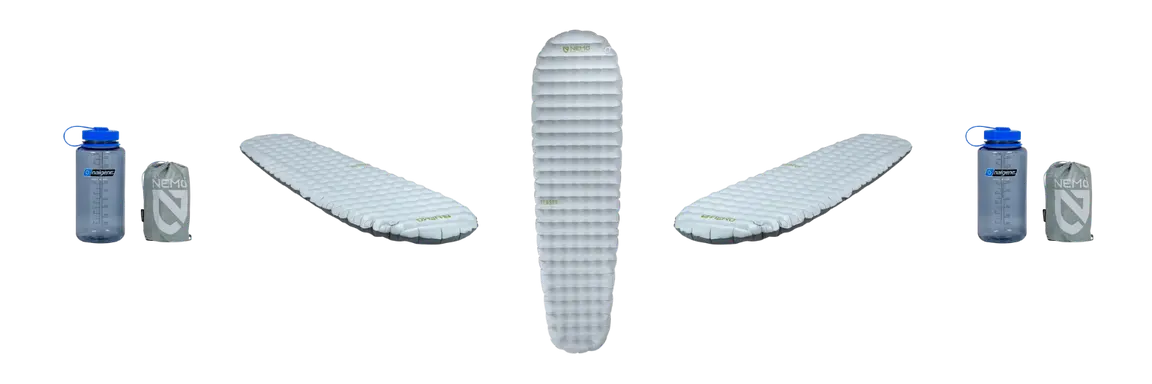
R-Value: 2.4 | Weight: 240g / ~8.5 oz (Regular Mummy) | Thickness: 3.0 in | Price: $229.95
The Tensor Elite is the pad you reach for when the needle on your scale won’t go any lower. At 240 grams, it’s one of the lightest inflatable pads that still delivers full three-inch loft and a usable sleeping surface. The 10D CORDURA nylon is impressively light while maintaining enough durability for real trail use.
The mummy silhouette shaves additional weight and the Apex baffle construction prevents the hammock-sag feeling that plagued earlier ultralight designs. The Laylow micro-adjustable valve gives you precise inflation control, useful when you’re dialing in firmness on different terrain. The R-value of 2.4 limits this pad to warmer conditions, spring through fall in most climates, so be honest with yourself about your trip temperatures before committing.
Why it’s on the list: Sub-250-gram comfort that doesn’t feel like a compromise. For summer thru-hiking or ultralight fastpacking in mild conditions, it’s the most compelling weight-to-comfort option available.
4. NEMO Tensor All-Season | Four-Season Favorite
R-Value: 5.4 | Weight: 15.5 oz (Regular) | Thickness: 3.5 in | Price: $219.95
The Tensor All-Season is for hikers who want legitimate four-season capability without migrating to expedition-weight gear. An R-value of 5.4 covers everything from late fall shoulder season to moderate winter camping, it’s the pad you can leave in your kit year-round without second-guessing yourself.
Two suspended layers of Thermal Mirror film bounce body heat back at you rather than letting it escape. Spaceframe baffle construction creates a stable sleeping surface that doesn’t shift under you through the night. At 3.5 inches of loft, the thickest on this list, it’s genuinely comfortable over rocky terrain. The included Vortex pump sack makes inflation fast and effortless, and like the XLite NXT, it achieves 83% noise reduction over previous generations.
Why it’s on the list: The most comfortable pad on this list for mixed-terrain camping, with enough insulation for genuine four-season use. Hikers who move between spring desert heat and fall alpine cold will appreciate not having to swap pads mid-season.
View the NEMO Tensor All-Season →
5. Sea to Summit Ether Light XR Insulated | Most Versatile
R-Value: 4.1 | Weight: 15.7 oz | Thickness: 3.9 in | Price: $189.00
At 3.9 inches thick, the Ether Light XR Insulated is the closest thing to a real mattress you’ll carry on trail. Sea to Summit’s Air Sprung Cell technology creates individual air pockets that respond independently to your movement, it sleeps more like a mattress and less like a balloon than most inflatable pads.
The integrated Airstream Pumpsack is the standout feature. Three to four full pumps inflates the pad completely, versus the 15–25 breaths required for manually inflated pads, a meaningful difference at altitude. The 30/40D nylon with TPU lamination is more puncture-resistant than many ultralight alternatives, making this pad more forgiving on abrasive desert terrain. The Pillow Lock System lets you attach a compatible Sea to Summit pillow directly to the pad.
Why it’s on the list: The best pad for hikers who prioritize sleeping comfort above all other variables, and who want the fastest, easiest inflation system available. At $189 it’s also the most affordable full-featured option on this list.
View the Ether Light XR Insulated →
6. Featherstone Calcatta Air | Best Value
R-Value: 5.6 | Price: $149.99
The Calcatta Air earns its value designation not by being cheap, but by delivering an R-value of 5.6, enough for serious cold-weather camping at $149, roughly a hundred dollars less than comparable-rated pads from Therm-a-Rest or NEMO.
The construction is well-considered: 20D Micro Ripstop Nylon with TPU treatment, offset baffles that eliminate the floating sensation common in budget inflatables, and extra-thick side rails that keep side sleepers from rolling off the pad. HeatLock Baffles and suspended reflective layers maintain meaningful warmth retention through cold nights. It comes with a repair patch kit and pump sack carry bag. It’s been selling out consistently, which says something about how the hiking community has responded to the value proposition.
Why it’s on the list: Cold-weather-capable insulation at a price that won’t require justification. If the $200+ options stretch your budget, this is where to look first.
View the Featherstone Calcatta Air →
7. Zenbivy Ultralight Mattress | Overlooked Budget Pick
R-Value: 4.8 | Weight: 17 oz
Zenbivy is better known for their sleeping bag systems than their pads, which means this mattress gets overlooked by buyers who would otherwise be well-served by it. At 17 ounces with an R-value of 4.8, it sits in three-season-plus territory at a lower price point than comparable options from better-known brands.
The 20D honeycomb embossed recycled polyester construction is tougher than it looks, and the texture adds grip so the pad doesn’t migrate under your bag overnight. Diagonal air cells create a supportive sleeping surface, and dual Mylar film layers provide the insulation. Available in tapered and rectangular versions, tapered saves a few ounces, rectangular gives you more room to move.
Why it’s on the list: A genuinely solid R-value for its price bracket that most buyers walk past. Worth a look if the Featherstone Calcatta is out of stock or if you prefer a rectangular sleeping platform.
View the Zenbivy Ultralight Mattress →
8. Therm-a-Rest Z Lite Sol | The Indestructible Minimalist
R-Value: 2.0 | Weight: 14 oz (Regular) | Thickness: 0.75 in | Price: $49.95
There’s an honest argument that the Z Lite Sol is the most practical pad on this list. It cannot puncture. It cannot fail. It requires zero setup beyond unfolding. And at $49.95, replacing it isn’t a financial event.
The accordion-fold design attaches to the outside of a pack easily and is instantly accessible at any rest stop, useful for quick breaks, sitting on wet ground, or improvised seating at camp. The ThermaCapture surface on the top side reflects body heat back at you, pushing warmth performance roughly 15% beyond untreated closed-cell foam. As a standalone pad it’s limited to warm conditions, but layered beneath any other inflatable on this list it adds meaningful insulation, and protects the more expensive pad from punctures. Many experienced winter hikers carry it specifically for this reason.
Why it’s on the list: Fifty dollars for bulletproof reliability. As a standalone pad in warm conditions or as a base layer under an inflatable in the cold, the Z Lite Sol has earned its place in more packs than any other pad on this list.
Going Lighter: Quilts and Dyneema Shelters
A good sleeping pad gets you off the ground. But if you’re serious about pushing your baseweight into ultralight territory; under 10 lbs, ideally under 8, the pad alone isn’t the story. The two biggest gains come from your sleep system and your shelter. Here’s where to look.
Switching to a Backpacking Quilt
A sleeping bag wraps around your entire body, including the section underneath you that’s compressed flat and provides zero insulation. A quilt eliminates that dead weight entirely. Most hikers who switch from a mummy bag to a quilt save between 8 and 14 ounces while sleeping at the same temperature rating, often warmer because they’re no longer relying on insulation that can’t do its job.
The adjustment period is real, some people take a few nights to sleep comfortably without a bag enclosing them. But for most long-distance hikers, the weight savings and the freedom of movement make it worth the transition. Here are the quilts worth considering:
Enlightened Equipment Revelation
One of the most configurable quilt options available, with temperature ratings from 50°F down to 0°F and a wide range of fill weights, widths, and lengths. EE’s direct-to-consumer model keeps pricing honest for the quality of construction. The Revelation has become the default quilt recommendation for PCT hikers and remains hard to beat at its price point. Starts around 14 oz in a 20° regular. Ships made-to-order.
Katabatic Gear Flex 22
Katabatic’s attachment system, a pad strap and elastic hem, is the best solution to cold drafts on the market. My personal favorite, the Flex 22, wraps snugly around most sleeping pads and eliminates the gap that wakes side sleepers at 4 AM. Around 15 oz for a 22°F rating, made in the USA, and performs consistently close to its stated temperature rating… something not every quilt can claim.
Zpacks Classic Quilt
If you want the lightest possible quilt without a custom order, the Zpacks Classic in 900-fill power down is the answer. The 30°F regular version comes in under 13 ounces. Paired with a pad rated R-4.5 or higher it handles three-season camping comfortably. Also available with a Dyneema shell for additional weight savings.
Jacks ‘R’ Better Sierra Sniveler
The budget entry point for down quilts from a cottage brand with decades of experience. Less refined than EE or Katabatic, but uses quality 800-fill down and is built honestly. A good first quilt if you’re not ready to commit $300+ before knowing whether quilts suit your sleep style.
Moving to a Dyneema Shelter
Dyneema Composite Fabric or DCF for short, is the most weight-efficient shelter material available. A well-designed DCF single-wall shelter will weigh 40–60% less than a comparable nylon option. For solo hikers, moving from a conventional tent to a Dyneema tarp or single-wall shelter is often the single biggest baseweight reduction available after addressing the sleep system.
DCF typically is seam taped by the manufacturer, and as with all shelters should be inspected before long trips. It’s not abrasion-resistant, so treat it accordingly. Within those constraints, it’s exceptionally durable for its weight and handles rain and wind far better than the ounce count suggests it should.
Zpacks Duplex (~21 oz)
The benchmark ultralight shelter. Two-person capacity, double-wall construction, requires two trekking poles. When pitched correctly it provides genuinely livable interior space. More thru-hikers use this shelter than any other DCF option, and the design has been refined over many production generations. If you’re buying your first Dyneema shelter and want the proven choice, start here.
Zpacks Hexamid Solo Plus (~14 oz)
For hikers who don’t need two-person capacity, the Hexamid Solo Plus drops to around 14 ounces with enough interior space for a single sleeper and their gear. The single-pole pitch is fast once you’ve done it a few times. On trails where you’re moving fast and camping light, it’s one of the most efficient shelters available.
Hyperlight Mountain Gear Mid-1 (~14 oz)
A single-pole mid in DCF that provides exceptional weather protection for its weight. The pyramid profile sheds wind and snow better than most tent designs, making it a strong choice for shoulder-season and exposed alpine terrain.
Gossamer Gear The One (~18 oz)
Not Dyneema, but the best bridge option: a silnylon single-wall shelter at around 18 ounces that offers DCF-like performance at roughly half the price. For hikers considering a move toward ultralight shelters but not ready for the DCF price tag, it’s the most natural stepping stone.
What the Numbers Look Like: A Sample Ultralight Big Three
| Item | Weight |
|---|---|
| Nemo Tensor Elite (pad) | ~8.5 oz |
| EE Revelation 20° quilt | ~14 oz |
| Zpacks Duplex (shelter) | ~21 oz |
| Total sleep system + shelter | ~43.5 oz / 2.7 lbs |
A conventional mummy bag, standard three-season tent, and foam pad setup typically runs 6–9 lbs. Moving to the above configuration recovers 3–6 lbs from your baseweight, the biggest single gain available on the gear side, and one that compounds across every mile you walk.