
This website uses affiliate links which may earn a commission at no additional cost to you. As an Amazon Associate I earn from qualifying purchases.
When you’re preparing for a thru-hike, the pack on your back becomes your home for thousands of miles. The ULA CDT Ultra positions itself as a frameless ultralight option designed for hikers who’ve already trimmed their gear to the essentials. Before you commit to this pack, you need to understand what “ultralight” actually means for your daily experience on trail.
Understanding the Weight Class
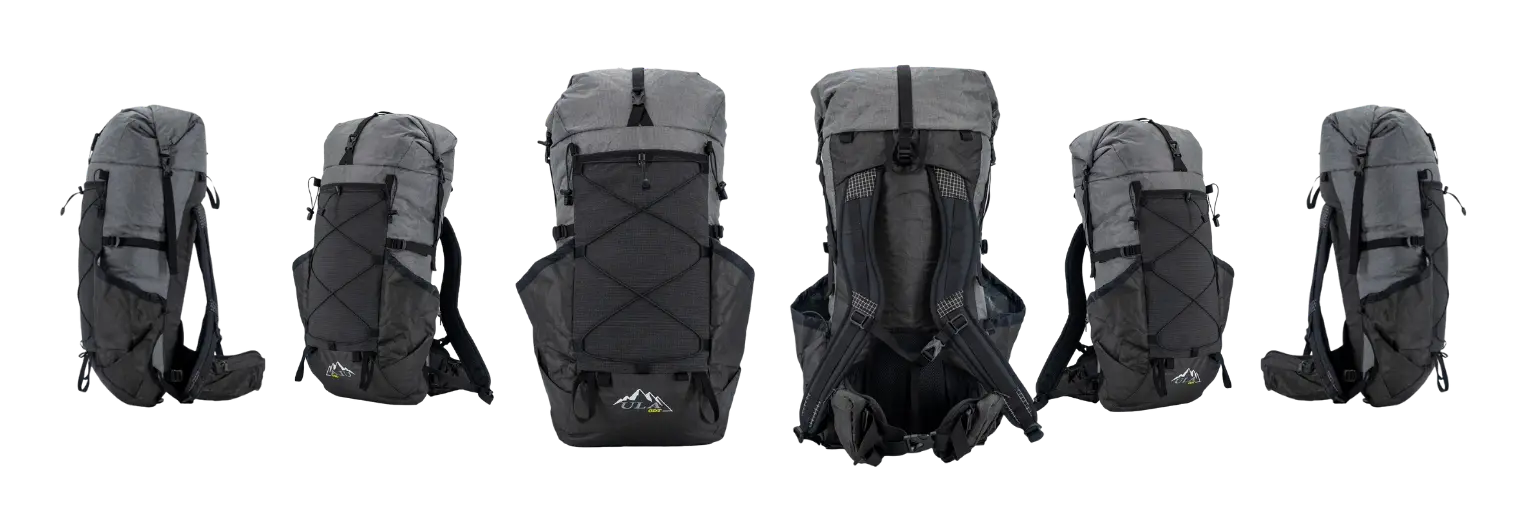
The ULA CDT weighs 20.2 ounces without the hipbelt. Add the hipbelt and you’re at 28.2 ounces total. For context, this is roughly half the weight of many traditional backpacking packs. This weight savings comes from specific design choices: there’s no internal frame, the fabric is thinner (though still durable), and features are stripped to what’s necessary.
This lightweight construction has a direct trade-off. The CDT is built for maximum comfort loads under 25 pounds. That total weight includes everything: your pack weight plus food, water, and worn items. If your base weight (gear without consumables) sits around 10-12 pounds, you’ll have room for several days of food and water while staying in the comfort zone. Push beyond 25 pounds regularly, and you’ll feel it in your shoulders and lower back.
Volume and Packing Reality
The CDT offers 54 liters of total volume, broken down across multiple compartments. The main body holds 28.7 liters, with additional space in the extension collar (7.4 liters), front mesh pocket (6.6 liters), and side pockets (5.7 liters each). The hipbelt pockets add 1.5 liters per side.
Here’s what this means practically: your sleeping bag, sleeping pad, shelter, and clothing will occupy the main body. The extension collar handles overflow when you’re carrying extra food before a long section. Side pockets swallow water bottles, and the front mesh pocket stretches to accommodate your rain jacket, ditty bag, or other items you want accessible without opening the main compartment.
The roll-top closure works like a dry bag. You fold the collar down on itself multiple times, then clip it to the sides. This creates water resistance (not waterproof, but highly water-resistant). When it’s not raining, you can simply fold the collar forward and clip it for faster access. You don’t need to roll and unroll constantly.
Materials and Durability Explained
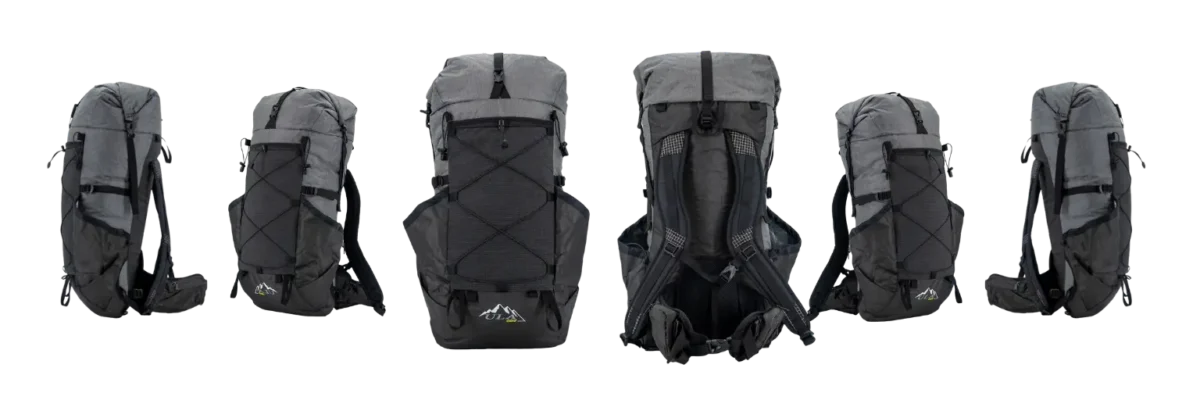
The CDT uses Challenge Ultra fabric in two weights. High-wear areas (bottom, pockets, back panel) get Ultra 400X, which handles abrasion better. Lower-stress areas (front, sides, collar) use Ultra 200X to save weight. This fabric is constructed from ultra-high molecular weight polyethylene, making it 15 times stronger than steel by weight and twice as abrasion-resistant as standard 420D nylon.
What does this mean on trail? The fabric resists tears and punctures better than traditional pack cloth at a fraction of the weight. It’s waterproof to 200 PSI, so rain beads off rather than soaking through. The material absorbs 80% less moisture than nylon, meaning your pack doesn’t gain weight in wet conditions.
The front pocket uses UltraStretch Mesh, a 4-way stretch material that’s more cut and abrasion-resistant than standard mesh. You’ll cram a surprising amount into this pocket without worrying about it tearing.
How Weight Transfers to Your Body
Without an internal frame, the CDT relies on your contoured shoulder straps and pass-through hipbelt to distribute weight. The shoulder straps come in two profiles: S-straps curve to match sloping shoulders, while J-straps stay straight for people with flatter shoulders. Getting this fit right matters significantly for comfort.
The hipbelt is minimal but functional at appropriate loads. It cinches your waist to keep the pack stable rather than transferring major weight to your hips like a framed pack would. At 15-20 pounds total pack weight, this system works smoothly. Push to 25 pounds, and you’ll notice the shoulder straps carrying more load than they would with a frame.
A removable foam back panel (1.9 ounces) sits between the pack and your back, providing minimal structure and cushioning. Many hikers use their folded sleeping pad here instead for additional padding and to give the pack more rigidity. Any foam or inflatable pad that folds (rather than rolls) works well.
Access and Organization Systems
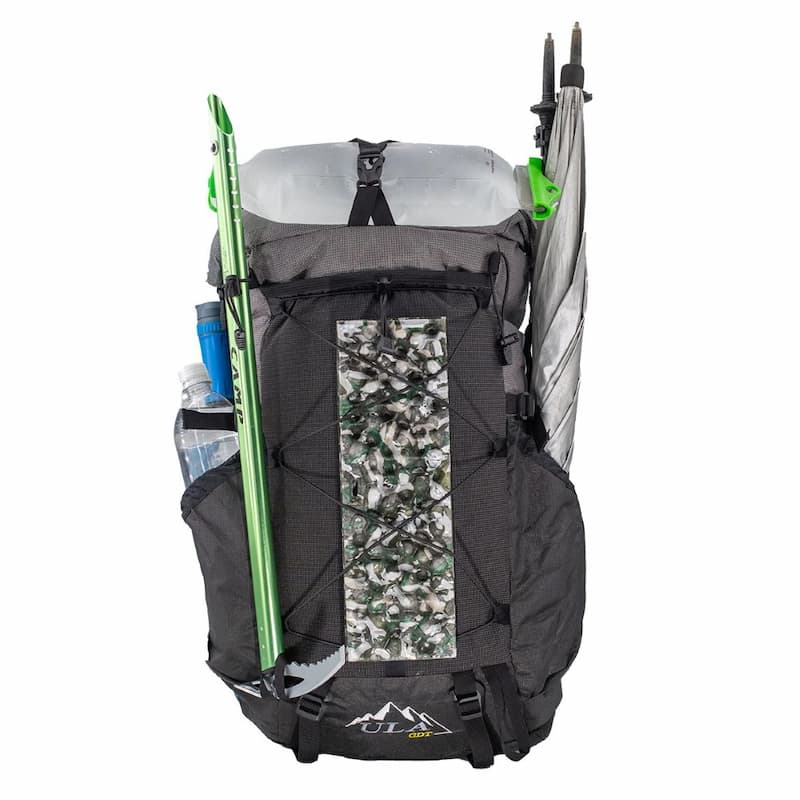
The pack uses adjustable side pockets that compress or expand based on what you’re carrying. Each pocket fits two one-liter bottles easily. The pockets angle toward the top, so most people can reach back and grab a bottle without removing the pack.
Hipbelt pockets accommodate most modern smartphones plus small items like lip balm, sunscreen, or energy bars. Having frequently-used items here eliminates the need to stop and dig through your pack constantly.
The shock cord system on the front lets you lash additional gear externally. Wet tent? Strap it to the front. Need to carry trekking poles while using your hands? The newly added ice axe/trekking pole loops handle this.
For 2024, ULA added low-profile loops at the top and bottom. Purchase the optional strap kits (sold separately), and you can attach external straps to carry a sleeping pad, tent, or bear canister on the outside of the pack. This adds versatility without permanently adding weight.
Packing Strategy
Loading the CDT follows a specific logic. Heavier items (food, cook system, water filter) sit close to your back in the middle third of the pack. Sleeping bag and puffy jacket fill the bottom. Shelter and clothing occupy the top and collar area.
The internal pad holster helps position your sleeping pad against your back. Alternatively, strap the pad to the bottom of the pack with the optional bottom strap kit. Some hikers prefer this for better ventilation against their back.
Bear canisters present a challenge in any frameless pack. Smaller canisters (like the BearVault BV450) fit vertically inside. Larger canisters need to be strapped externally to the top using the optional Y-strap kit. This isn’t ideal for balance, but it works for sections where canisters are required.
Weight Reduction Options
The minimalist design means there’s not much left to remove, but options exist. You can order the pack without a hipbelt, saving 8 ounces and $30. If your total pack weight stays under 15 pounds, this works. Remove the back panel foam for another 1.9 ounces. The sternum strap adds 2.0 ounces if you choose to keep it.
Trim excess webbing on straps to save a few more grams. These modifications only make sense if you’re chasing an ultralight setup and understand the comfort trade-offs.
Maintenance and Care
Cleaning Ultra fabric is straightforward. Spot clean with mild soap and water. For deeper cleaning, hand wash in a tub with gentle detergent, rinse thoroughly, and air dry. Don’t put it in a washing machine or dryer. The fabric doesn’t absorb water, so it dries quickly when hung.
The fabric resists UV degradation better than traditional nylon, meaning the pack won’t lose strength from sun exposure as quickly. Color fading happens more slowly too.
ULA offers a lifetime warranty against defects in materials and workmanship. This doesn’t cover normal wear or damage from misuse, but manufacturing issues are covered. They also provide tune-up and repair services for packs that need adjustment or fixing after heavy use.
Packed Size and Transport
When empty, the Ultra CDT compresses nearly flat. This makes it easy to stuff into a gear bag or overhead compartment when you’re not on trail. The pack doesn’t have rigid components that make packing awkward.
Fully loaded, the pack’s dimensions depend on how you’ve packed it and whether you’re using the extension collar. A well-packed CDT maintains a narrow profile that doesn’t catch on brush or throw off your balance on narrow trail sections.
Real-World Performance Considerations
Weather resistance is excellent for a pack without a rain cover. The Ultra fabric sheds water effectively. However, the roll-top closure, while water-resistant, isn’t fully waterproof. Extended downpours can eventually work moisture through the closure or seams. Most thru-hikers use a pack liner (trash compactor bag or dedicated dry bag) for critical items like sleeping bags and electronics.
Temperature range doesn’t affect the pack significantly. Ultra fabric stays flexible in cold conditions (unlike some laminated materials that stiffen). In heat, the minimal back padding means better ventilation but less cushioning against gear poking into your back.
Trail conditions matter for longevity. The Ultra fabric handles abrasion from brush and rocks well. Sharp granite edges or prolonged sliding across rocks will eventually wear any fabric, but this material resists damage better than most ultralight options.
Fit Requirements
Getting the correct torso length determines whether the pack carries comfortably. Measure from your C7 vertebra (the bump at the base of your neck) down your spine to the top of your hipbone. ULA offers small (15-18 inches), medium (18-21 inches), large (21-24 inches), and extra-large (24+ inches) torso sizes. If you’re between sizes, ULA recommends sizing up for frameless packs.
Hipbelt sizing follows a formula: men add 2 inches to waist size, women with curvy hips add 5 inches to the smallest part of their waist, women with straight hips add 3 inches. The belt should sit on your hip bones, not your waist.
Shoulder strap choice depends on your shoulder slope. Look at your profile in a mirror. Sloping shoulders need S-straps; square shoulders work better with J-straps. Getting this wrong leads to straps sliding off or digging into your neck.
When the CDT Makes Sense
This pack excels for hikers with base weights under 12 pounds who primarily hike in three-season conditions. If you’re carrying a lightweight quilt, frameless shelter, and minimal clothing, the CDT provides enough volume without excess capacity.
Section hikers who resupply frequently (every 3-4 days) and don’t need to carry large food loads work well with this pack. The limited capacity forces efficiency in gear selection.
Fast-and-light enthusiasts who prioritize miles over comfort will appreciate the weight savings. When you’re covering 25-30 miles daily, every ounce on your back matters.
When to Choose Something Else
If your base weight exceeds 15 pounds, consider a framed pack. The CDT won’t carry heavier loads comfortably, and you’ll struggle on longer food carries.
Winter hiking requires bulkier insulation, larger sleeping bags, and additional safety gear. The 54-liter capacity becomes restrictive quickly.
Beginners still figuring out their gear system benefit from the flexibility of a larger, framed pack. As you dial in your kit and reduce weight, you can transition to something like the CDT later.
Photographers or specialized gear carriers need external attachment points and more organizational pockets than the CDT provides.
The Bottom Line
The ULA CDT is a purpose-built tool for lightweight distance hiking. It performs exceptionally well within its design parameters: loads under 25 pounds, three-season conditions, and hikers who value weight savings over maximum comfort. The Ultra fabric delivers legitimate durability at minimal weight, and the simple design means fewer components to fail.
Understanding the pack’s limitations matters as much as knowing its strengths. This isn’t a do-everything pack. It’s a focused piece of equipment for hikers who’ve already committed to going ultralight and understand the trade-offs involved.
Before purchasing, honestly assess your typical pack weight, resupply strategy, and hiking style. If the numbers align with the CDT’s capabilities, it’s one of the most capable ultralight frameless packs available. If your needs fall outside those parameters, choosing appropriate gear saves you discomfort over thousands of miles.