

This website uses affiliate links which may earn a commission at no additional cost to you. As an Amazon Associate I earn from qualifying purchases.
The Hyperlite Mountain Gear Mid 1 represents a specific approach to backcountry shelter: the single-wall, pyramid-style tarp tent. This isn’t a beginner’s first tent, and it’s not trying to be. It’s designed for people who understand the trade-offs of going ultralight and are willing to learn a different camping system in exchange for carrying significantly less weight over thousands of miles.
When you’re standing in your living room trying to decide if this shelter makes sense for your thru-hike, you’re really asking whether you’re ready to trade convenience and interior space for a shelter system that disappears in your pack.
Why Thru-Hikers Choose This Shelter
The Weight Argument Is Real
For thru-hikers specifically, the weight proposition of the HMG Mid 1 becomes increasingly relevant the longer you’re on trail. Carrying this shelter instead of a traditional two-pound tent saves you roughly half a pound to a full pound depending on what you’re comparing it to. Over the course of a thru-hike, that’s thousands of vertical feet of elevation you don’t have to carry.
But weight savings mean nothing if the shelter can’t handle what you’re throwing at it. The Mid 1 has established itself on long trails because it performs in the conditions thru-hikers actually encounter.
Single-Wall Reality Check
The Mid 1 is a single-wall shelter, which means the same Dyneema fabric that keeps rain out is also your only barrier between you and the outside air. This has real implications you need to understand before you buy.
In humid conditions or when you’re camping near water, you will get condensation on the interior walls. This is physics, not a design flaw. The Mid 1 addresses this with dual peak vents that create airflow when properly pitched, but you cannot eliminate condensation in a single-wall shelter when the temperature differential and humidity are high enough.
What you gain is simplicity. There’s no inner tent to pitch, no poles to assemble, no fly to attach. In a rainstorm, you’re setting up one piece of fabric and getting inside. When you wake up to weather and need to pack fast, you’re pulling stakes and stuffing one thing in your pack. After two months on trail, this simplicity becomes valuable.
The Trekking Pole Integration
The Mid 1 requires one trekking pole for setup. If you don’t hike with at least one trekking pole, this shelter doesn’t make sense for you.
For thru-hikers who already use trekking poles (which is most people on long trails), this design eliminates tent poles from your pack entirely. It’s not just about weight; it’s about one less thing to break, lose, or worry about. The pole jack inside the tent creates a solid connection point, and the pyramid design distributes stress across the entire structure rather than concentrating it on pole joints.
Your trekking pole is doing double duty: stabilizing you during the day and holding up your home at night.
Space Considerations and the Pyramid Shape
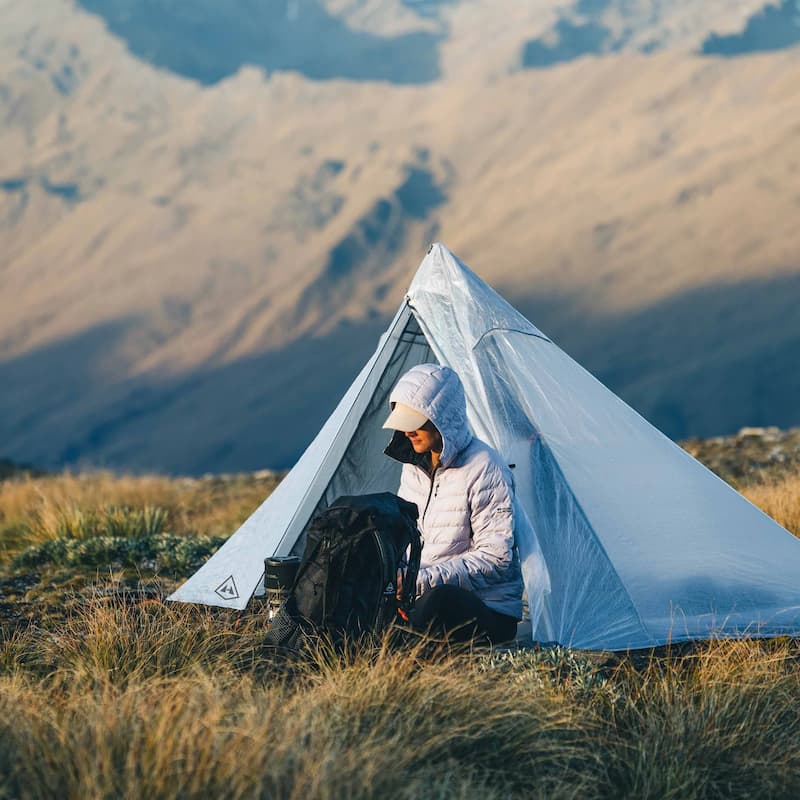
The pyramid design creates a shelter with a high center peak that tapers to low edges. At the center, you have generous headroom for sitting up and organizing gear. At the perimeter, the walls slope down significantly.
This means your usable floor space is smaller than the actual floor dimensions suggest. You’re sleeping in the middle, and gear that doesn’t fit inside gets stored in the vestibule. For solo thru-hikers with a dialed kit, this works. Your pack, shoes, and cooking setup fit in the vestibule. Your sleeping system and essentials stay inside with you.
If you’re someone who likes to spread out, or if you carry a lot of gear inside your shelter, the tapered walls will feel restrictive. The Mid 1 rewards people who have refined their systems and don’t need a lot of interior space.
Pitching and Site Selection
The Mid 1 is non-freestanding, which means it needs to be staked out to stand up. You cannot pitch this shelter on hard surfaces like solid rock or wooden platforms. You need soil or sand that will hold stakes.
For thru-hikers on established trails, this is rarely a problem. Most designated campsites have suitable ground. Where it becomes relevant is in stealth camping situations or when you arrive at a site and find limited suitable pitching spots.
The single-pole pyramid design is actually more forgiving than some other non-freestanding shelters because you only need to find one good spot for your center pole, rather than two perfect points for a ridgeline. The rectangular floor shape also makes it easier to fit into irregular spaces compared to hexagonal or pentagonal floors.
You need to carry enough stakes and know how to use them. The shelter comes with stake-out points, and using all of them in high wind is important. In gentle weather, you can get away with fewer stakes, but learning proper pitching technique matters with this shelter.
Weather Performance Over Long Trails
Thru-hikers experience the full spectrum of conditions, and the Mid 1’s track record on trails like the PCT, AT, and CDT demonstrates its weather capability.
The Dyneema fabric is completely waterproof and doesn’t absorb water. Unlike silnylon shelters that sag when wet and need to be re-tensioned, the Mid 1 maintains its pitch in rain. You set it up tight once, and it stays tight.
In wind, the pyramid shape is inherently stable. Wind flows over and around the structure without creating lift. The low profile reduces wind loading compared to dome tents. When properly staked and guyed out, the Mid 1 holds in conditions that would flatten less aerodynamic designs.
The dual peak vents create airflow that helps manage condensation and prevent the shelter from becoming a sail in wind. They’re positioned at the apex where heat and moisture naturally rise, making them more effective than side vents.
Cold weather performance is where single-wall shelters show their limitations. In freezing conditions, any moisture you create inside (from breathing, from wet gear) will condense and potentially freeze on the interior walls. This is manageable but requires awareness. Many thru-hikers use the Mid 1 in shoulder season and winter, but you need to understand you’ll be dealing with frost on the inside walls when temps drop.
Durability for the Long Haul
Dyneema Composite Fabric (DCF) has a specific durability profile. It’s not bombproof fabric that can handle anything. It’s high-strength-to-weight fabric that performs well when used within its design parameters.
DCF doesn’t tear easily under tension, which is what makes it excellent for shelters. The fabric is under constant tension when pitched, and it handles this stress well. Where DCF shows wear is from abrasion and repeated creasing at the same points.
For thru-hikers, this means being thoughtful about site selection. Pitching on sharp rocks, pinecones, or abrasive surfaces will cause accelerated wear. The floor is the most vulnerable area, and many Mid 1 users either place their pack under their legs or use a small piece of Tyvek as a pad under high-wear areas.
The seams are taped, not sewn and then sealed. This creates waterproof seams that don’t require maintenance, but it also means if a seam fails, you cannot easily repair it in the field with a needle and thread. Carrying DCF repair tape is essential.
Over the course of a thru-hike, you should expect some wear on high-stress points, but the shelter should remain functional if you’re not abusing it.
The Vestibule Strategy
The Mid 1 has vestibule space created by the way the door panels extend. This isn’t a massive gear garage, but it’s functional space for the things you need outside your sleeping area.
Your cooking setup stays in the vestibule. Your shoes stay in the vestibule. Your pack can lean against the outside or sit in the vestibule depending on size. This separation of clean sleeping space and dirty/wet gear space is important for comfort over long periods.
The zippered door can be opened partially or fully, and it has magnetic keepers that hold it in place. This matters more than it sounds like it would. Being able to secure the door without fumbling with toggles when you’re getting in and out becomes appreciated over time.
What This Shelter Teaches You
Using the Mid 1 makes you better at camping. You learn to read terrain for pitching sites. You learn to tension a shelter properly. You develop judgment about when to add guy lines and when you can skip them. You become efficient at setup because the system is simple enough to master.
For thru-hikers, these skills compound over months on trail. By the time you’re halfway through a thru-hike with the Mid 1, you can pitch it in under three minutes in the dark in the rain without thinking about it.
The Minimalist Mindset
The Mid 1 appeals to a specific type of thru-hiker: someone who is willing to adapt their system to save weight rather than expecting their gear to accommodate every preference. If you want a tent with multiple doors, standing height throughout, and generous floor space, this isn’t your shelter.
What you get instead is a highly functional tool that does exactly what it needs to do without carrying extra weight for features you don’t need. It’s a shelter that disappears in your pack and sets up fast when you’re tired.
Site Footprint and Stealth
The rectangular floor and relatively compact footprint make the Mid 1 easier to fit into smaller sites compared to larger shelters. For thru-hikers who occasionally stealth camp or arrive late to crowded sites, this flexibility matters.
The single-wall, single-pole design also means faster setup and teardown, which is relevant both for weather situations and for stealth camping scenarios where you want to be less conspicuous.
When This Shelter Makes Sense
The Mid 1 is the right choice for thru-hikers who:
- Already hike with at least one trekking pole
- Have refined their gear systems and don’t need much interior space
- Understand and accept single-wall shelter condensation
- Value weight savings enough to trade convenience for it
- Are comfortable with non-freestanding shelter setup
- Want a shelter that will last an entire thru-hike without babying it
When to Look Elsewhere
Consider alternatives if you:
- Don’t use trekking poles and don’t want to start
- Need more interior space for gear or personal comfort
- Want a freestanding shelter for flexibility on all surfaces
- Prefer the convenience of double-wall designs
- Are on a tight budget (DCF shelters are expensive)
- Camp frequently in very cold conditions where frost management is a primary concern
The Bottom Line for Thru-Hikers
The HMG Mid 1 represents a proven ultralight shelter option with a solid track record on long trails. It’s not the lightest shelter available, and it’s not the cheapest, but it sits in a sweet spot of weight, durability, and weather protection that works for thru-hiking.
If you’re ready to commit to the learning curve and the trade-offs, the Mid 1 will serve you well for thousands of miles. If you’re still figuring out your system or want more forgiveness in your shelter choice, gaining more experience before investing in this shelter makes sense.
The question isn’t whether the Mid 1 is a good shelter, it is. The question is whether it’s the right shelter for how you hike and what you prioritize.