
This website uses affiliate links which may earn a commission at no additional cost to you. As an Amazon Associate I earn from qualifying purchases.
If you’re planning your first thru-hike, you’ve probably stumbled across the Enlightened Equipment Revelation quilt in your research. It shows up in every gear list, every forum thread, every “what I wish I knew” video. But understanding why it’s so popular and whether it’s right for you requires looking beyond the specs.
This guide breaks down everything a beginner needs to know about the EE Revelation, focusing on the practical realities of using this quilt over hundreds or thousands of miles.
Understanding What a Quilt Actually Is
Before diving into the Revelation specifically, you need to understand what makes a quilt different from a traditional sleeping bag. A quilt has no back insulation. The logic is simple: when you lie on a sleeping bag, your body weight compresses the insulation underneath you, rendering it essentially useless. You’re relying on your sleeping pad for insulation from below anyway.
By eliminating that compressed, non-functional insulation, you save weight and bulk. For a thru-hiker carrying everything on their back for months, this weight savings is not trivial. We’re talking about 8 to 12 ounces compared to an equivalent sleeping bag, and when you’re trying to get your base weight under 10 pounds, every ounce is a victory.
The tradeoff is versatility. A sleeping bag can be used on any surface. A quilt requires a sleeping pad. For thru-hiking, this isn’t really a tradeoff at all since you’re already carrying a pad.
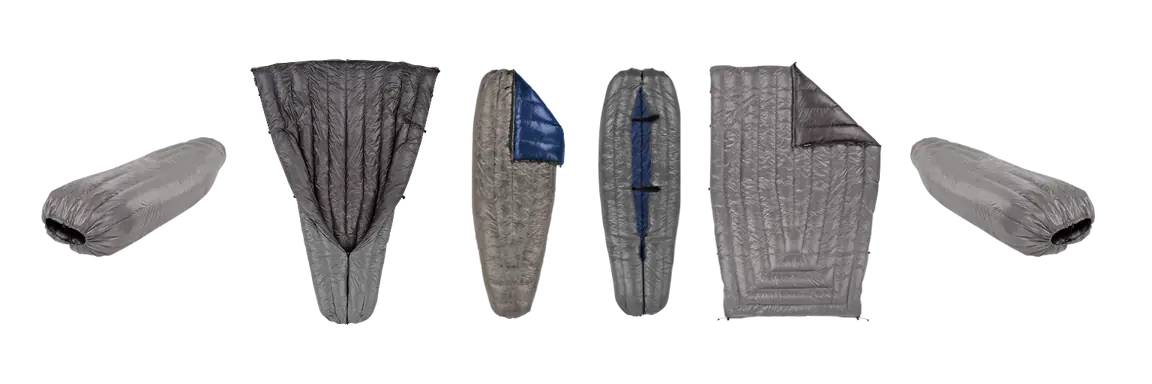
Weight and Packed Size: The Numbers That Matter
Let’s talk actual weights because this is where the Revelation shines. A 20-degree Revelation in regular width and length with 850-fill down and 10D fabric weighs approximately 16 to 18 ounces. Compare that to a traditional 20-degree down sleeping bag at 24 to 30 ounces, and you’re saving half a pound or more.
For packed size, the Revelation compresses down to roughly the size of a Nalgene bottle when stuffed into a compression sack. In your pack, this typically means it takes up about 6 to 8 liters of space. You can fit this quilt in the bottom of almost any backpack without it dominating your entire pack volume.
The practical impact: you can use a smaller, lighter pack. Your pack sits better on your hips. You’re not fighting with a bulky sleeping bag every time you need something from the bottom of your pack. Over 2,000 miles, these small conveniences compound into significant quality of life improvements.
Temperature Ratings: What the Numbers Actually Mean
Enlightened Equipment offers the Revelation in temperature ratings from 50 degrees down to negative 20 degrees Fahrenheit. The most common choice for thru-hikers is the 20-degree or 30-degree rating, depending on the trail and season.
Here’s what you need to know about these ratings: they’re conservative and generally honest. A 20-degree Revelation will keep most people comfortable down to about 20 degrees when paired with a decent sleeping pad (R-value of 4 or higher), appropriate clothing layers, and a full stomach.
If you’re a cold sleeper (someone who always feels chilly), consider going one rating warmer than you think you need. If you’re a hot sleeper, you can push the ratings a bit. The Revelation’s adjustable features help here. You can open the foot box fully on warm nights or cinch everything down tight when it’s cold.
Real-world performance: On the Appalachian Trail, hikers regularly experience nights in the 20s and 30s, even in summer at elevation. A 20-degree quilt handles this comfortably. On the Pacific Crest Trail, where you might hit freezing temperatures in the Sierra, that same 20-degree quilt works if you’re willing to sleep in your puffy jacket and extra layers on the coldest nights.
Setup and Daily Use: The Learning Curve
The Revelation uses a pad attachment system with straps and clips. You run straps around your sleeping pad and clip them to the sides of the quilt. This keeps the quilt from sliding off you during the night and prevents drafts from sneaking in around the edges.
The first few nights are awkward. You’ll wake up with drafts. You’ll fumble with the clips in the dark. You’ll wonder if you made a terrible mistake. This is normal. By night five or six, setup becomes automatic. You’ll be able to attach the quilt to your pad in under 30 seconds without thinking about it.
Getting in and out is simpler than a mummy bag. No zippers to fight with, no confined feeling, no claustrophobia. You drape it over yourself, clip in the sides, and you’re done. In the morning, you unclip and you’re out. For middle-of-the-night bathroom trips, this convenience is genuinely valuable.
The quilt has a cinchable neck closure and an adjustable foot box. The neck closure is a simple drawcord that you tighten around your shoulders to prevent heat loss. The foot box can be fully opened for warm nights or cinched closed for cold nights. Both adjustments take seconds and can be done from inside the quilt.
Durability: What Holds Up and What Doesn’t
The Revelation is available in different fabric weights: 10 denier, 15 denier, and 20 denier. Most thru-hikers choose 10D for the weight savings, accepting that it requires more care. The 10D fabric is surprisingly tough for how light it is, but it’s not bombproof.
Common wear points: The area where the quilt contacts your sleeping pad sees the most abrasion. The attachment points where clips connect can develop stress over time. The stuff sack compression can gradually wear the fabric if you’re stuffing aggressively every day for months.
Realistic expectations: A 10D Revelation will last a thru-hike without major issues if you’re reasonably careful. Avoid setting it down on rough surfaces. Don’t let it drag on the ground. Keep it away from sharp objects and Velcro. Basic precautions go a long way.
After 2,000+ miles, expect some minor wear. Small holes can be patched easily with repair tape. Seams stay intact. The down loft holds up well. Many hikers report using the same Revelation for multiple thru-hikes with proper care.
If durability is a major concern, the 20D fabric option adds only 2 to 3 ounces and provides noticeably more abrasion resistance. For hikers who are harder on gear or less confident in their ability to baby delicate equipment, this is a smart upgrade.
Care and Maintenance on Trail
Keeping your quilt clean on trail is mostly about prevention. Use a sleeping pad and a ground sheet to keep it off the dirt. Air it out every morning if possible, draping it over your tent or backpack while you eat breakfast and pack up. This lets moisture from your body evaporate and prevents the down from clumping.
Spot cleaning is your friend. A damp bandana can wipe off dirt from the outside. For the inside, where body oils accumulate, occasional spot cleaning with water and a tiny amount of soap helps. Don’t soak the quilt on trail. A full wash should wait until town stops or post-hike.
In town, you can wash the Revelation in a front-loading washing machine on gentle with down-specific soap. Most hikers wash their quilt once or twice during a thru-hike, usually when staying in town for a zero day. Dry it on low heat with clean tennis balls or dryer balls to break up clumps and restore loft.
Moisture management is critical. Down loses insulating ability when wet. If your quilt gets damp from condensation or rain, prioritize drying it out. Hang it in the sun during breaks. Sleep with it open if the night is warm enough. In wet climates like the Pacific Northwest, some hikers add a waterproof stuff sack or pack liner as extra protection.
Customization: Building Your Perfect Quilt
EE offers extensive customization, which is both a blessing and a curse for beginners. You have to make choices, and wrong choices can affect your comfort for an entire thru-hike.
Temperature rating: For a thru-hike starting in spring, 20 degrees is the most versatile choice. It handles cold spring mornings and occasional summer mountain passes without overheating you on warm nights. If your hike is summer-only at lower elevations, 30 degrees might suffice.
Width and length: Regular width (54 inches) works for most people. Wide (58 inches) is better if you’re broad-shouldered, toss and turn, or want more coverage. For length, measure your height and add a few inches. You want the quilt to cover from your shoulders to past your feet when you’re stretched out.
Fill weight: More down means warmer temps but also more weight. EE’s recommendation system is accurate. Trust it.
Fabric weight: 10D for ultralight builds, 20D for durability. 15D is a middle ground that many thru-hikers find ideal, balancing reasonable weight savings with better durability.
Overstuff: You can pay extra for 2 or 4 ounces of additional down. This extends the temperature rating by roughly 5 to 10 degrees. If you’re between ratings or know you sleep cold, overstuffing is cheaper than buying the next warmest rating and adds less weight.
Color: Purely aesthetic, but darker colors hide dirt better over a long hike.
The Cost Reality
The Revelation isn’t cheap. Expect to pay $300 to $400 depending on your configuration. For someone outfitting their first thru-hike, this number can be shocking.
Here’s the perspective shift: divide that cost by the number of nights you’ll use it. On a thru-hike, that’s 150 to 180 nights. Suddenly you’re looking at $2 per night or less. A cheap sleeping bag that leaves you cold costs you sleep, recovery, and enjoyment. A quality quilt that keeps you comfortable is worth every dollar.
Resale value is also high. If you decide thru-hiking isn’t for you or you want to upgrade, EE quilts hold their value well in the used market. You can typically recoup 60 to 70 percent of your cost.
Compare this to budget sleeping bags in the $100 to $150 range. They’re heavier (often by a pound or more), bulkier, and less versatile. They don’t last as long. They don’t keep you as comfortable. The upfront savings evaporate when you factor in the performance difference over thousands of miles.
Who Should Choose the Revelation
This quilt is ideal for:
- Thru-hikers prioritizing weight savings
- Three-season backpackers who want versatility
- People who sleep warm or temperature-variable
- Hikers willing to learn a new sleep system
- Anyone building an ultralight kit
Consider alternatives if:
- You’re a very cold sleeper who needs maximum warmth
- You mostly camp below 20 degrees
- You want the simplicity of a mummy bag
- You sleep on rough ground without a pad
- You’re extremely hard on gear and need maximum durability
The Bottom Line for Beginners
The EE Revelation has earned its reputation on all thru-hikes with consistent performance at minimal weight. It’s not perfect. It requires a learning curve. It demands some care. But for thru-hiking, where weight and packability directly impact your daily experience, it’s one of the best values in ultralight gear.
Start by being honest about your sleep habits. Know whether you sleep hot or cold. Understand the typical temperatures on your planned trail. Use that information to choose your temperature rating. Don’t overthink the fabric weight or minor customizations.
Order early. EE’s lead times can be 4 to 8 weeks during busy season. This quilt needs to arrive in time for you to test it on shorter trips before your thru-hike. Those shakedown hikes will teach you how to set it up, how it fits your sleep style, and whether your temperature rating is appropriate.
Thousands of thru-hikers choose the Revelation every year because it works. It’s light enough to forget about, warm enough to trust, and durable enough to finish. For a beginner, that reliability matters more than chasing the absolute lightest or absolute cheapest option. This is a piece of gear you’ll use every single night on trail. Choose something that works.