
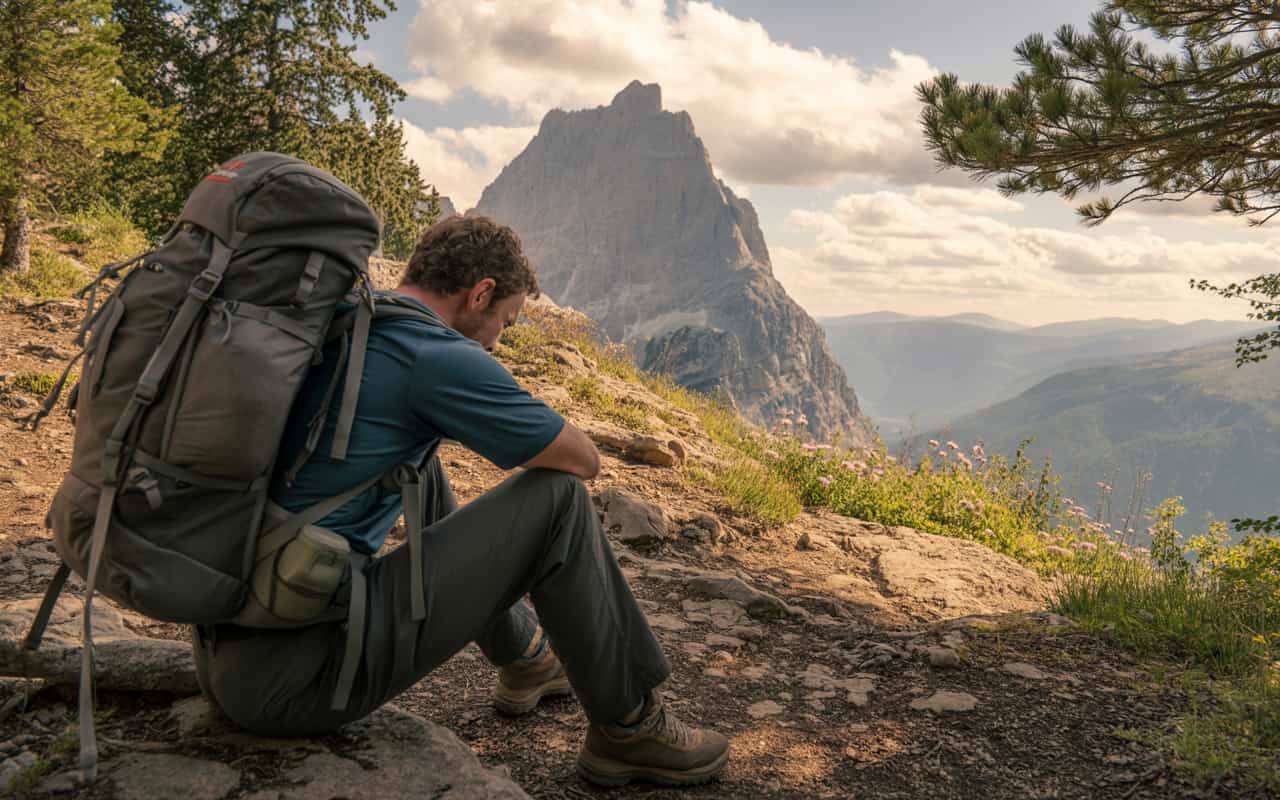
You’ve heard it a thousand times. Maybe you’ve said it yourself, late at night scrolling through trail photos from two years ago: “Those were the best days of my life.”
It feels true. On the trail, everything made sense. Wake up. Walk. Eat. Sleep. Repeat. The clarity was intoxicating. The community felt like family. Every ridge line delivered a hit of wonder you can’t seem to find in your Tuesday morning commute.
But here’s what nobody tells you when you’re standing at Katahdin or the Canadian border or wherever your journey ended: framing the trail as your peak is one of the most limiting beliefs you can carry home.
The Trail Wasn’t Your Climax. It Was Your Teacher
When you hold the trail up as the unreachable high point of your existence, you’re not honoring what happened out there. You’re freezing it in amber. You’re turning five months of growth into a museum exhibit labeled “better than anything that came after.”
The trail didn’t give you the best days of your life. It gave you something far more valuable: it showed you what you’re capable of when the unnecessary falls away. It taught you that discomfort is survivable, that strangers become family fast, that your body is stronger than your doubt and that joy doesn’t require much.
Those weren’t lessons meant to live only in the mountains. They were meant to reshape everything that came next.
The hikers who thrive after their thru-hike understand this instinctively. They don’t treat the trail like a vacation they can never recreate. They treat it like a blueprint.
Signs You’re Stuck in the “Best Days” Trap
You scroll trail photos daily. Not occasionally for nostalgia but constantly, like you’re trying to crawl back through the screen. The present feels gray by comparison.
Everything feels flat. Your job, your relationships, your weekends. Nothing delivers the same sense of purpose or aliveness. You describe your current life using words like “fine” and “whatever.”
You can’t engage with present opportunities. Friends invite you places. New projects appear. Potential adventures knock. But nothing sounds as good as what you had, so you decline. You’re waiting for something to feel like the trail felt.
You talk about the trail in past tense like it’s over. “I used to wake up every day excited.” “Back when I was strong.” “Those people understood me in a way no one here does.” You’ve made the trail your identity’s past tense.
You feel stuck between two worlds. You don’t fit in “normal” life but you also can’t (or won’t) figure out how to build a life that bridges who you became out there with where you are now.
If you recognize yourself here, take a breath. This isn’t failure. It’s grief mixed with misunderstanding. And it’s fixable.
Signs You’ve Integrated the Experience
You seek challenge elsewhere. Maybe it’s not a trail. Maybe it’s a creative project that scares you, a relationship that requires vulnerability or a skill that takes years to build. You learned you need meaningful struggle, so you find it.
You appreciate stillness AND movement. The trail taught you both. You don’t need to be moving 20 miles a day to feel alive but you also don’t sit still when your body craves motion. You’ve found your rhythm.
You’ve built a life that reflects trail values. This looks different for everyone. For some it’s minimalism. For others it’s prioritizing time outdoors. For many it’s choosing connection over convenience and presence over productivity. You’re not trying to recreate the trail but you’re living by what it taught you.
You can hold both truths. The trail was extraordinary AND your life now has meaning. You miss aspects of it AND you’re genuinely excited about what you’re building. The trail changed you AND you’re still changing.
You talk about the trail as a chapter, not the climax. When someone asks about your hike, you don’t sigh wistfully like you’re describing a dead lover. You talk about it as a transformative experience that led you here (wherever here is) with intention.
The Story You Tell Yourself Matters
Here’s the shift: the trail wasn’t the peak. It was the part of the climb where you learned how to climb.
Every skill you gained out there (resilience in discomfort, radical presence, community-building with strangers, navigating with incomplete information, celebrating small wins, pushing through when everything hurts) those aren’t trail skills. They’re life skills. They apply to relationships, careers, creative pursuits, parenting, activism and everything else.
When you frame the trail as “the best days,” you’re saying: “I peaked. It’s downhill from here. Nothing will ever measure up.”
When you frame the trail as a teacher, you’re saying: “I learned something profound. Now I get to apply it. The best part is what I build with these tools.”
One story traps you. The other frees you.
So What Now?
If you’re stuck in the “best days” loop, the way forward isn’t to forget the trail or minimize what it meant. It’s to ask better questions:
- What did the trail teach me about what I need to feel alive? (Not “how do I recreate the trail” but “what core needs did it meet?”)
- Where am I choosing comfort over growth? (The trail forced growth. Your current life probably doesn’t. Where can you choose it?)
- What would my trail self think of how I’m living now? (Not to shame yourself but to reconnect with the person who walked 2,000+ miles. What would they want for you?)
- Who in my life now reflects the trail values I want to keep? (Find your people. They might not be hikers but they’ll share your values.)
- What’s one way I can bring trail mindset into this week? (Start small. Say yes to discomfort. Initiate connection. Spend a day without your phone. Notice what’s right in front of you.)
The Truth About the Best Days
Here’s what I believe: your best days aren’t behind you. They’re not even ahead of you. They’re available to you right now, if you bring what you learned on the trail into how you show up today.
The trail was never meant to be the story. It was meant to be the part of the story where you became the person capable of writing the rest.
So write it. Build it. Walk it. Live it.
The trail already showed you how.
What story are you telling yourself about your thru-hike? Drop a comment below and let’s figure this out together.